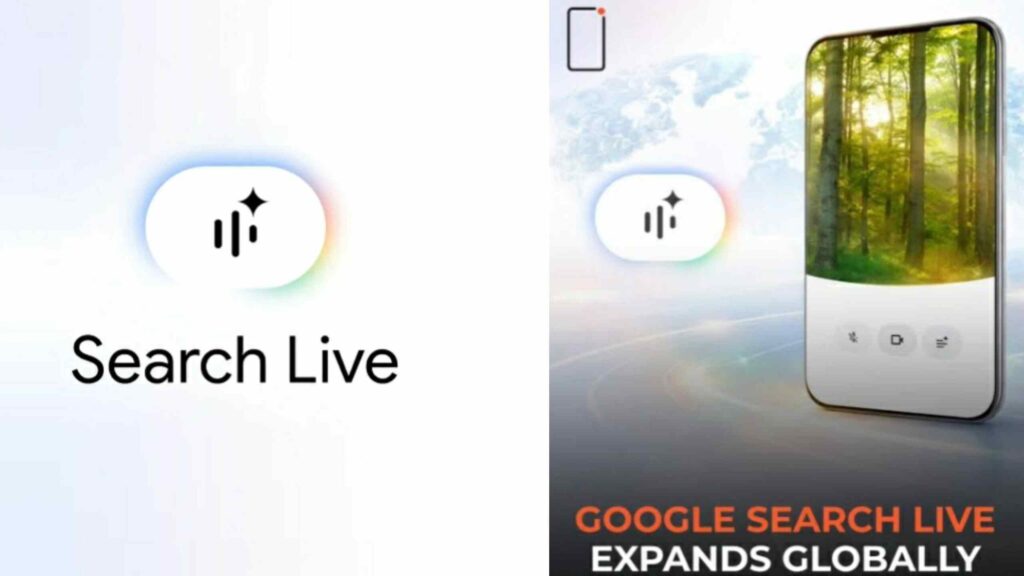
Google has expanded its Search Live feature worldwide, now offering users in over 200 countries and territories the ability to interact with Search through real-time, multimodal conversations using voice and a live camera feed. Originally launched in English across the United States last September, this week’s update brings the feature to a global audience.
Liza Ma, Google’s director of product management for Search, announced the expansion on the company’s blog, framing Search Live as a tool designed for moments when typing a query simply doesn’t work. The rollout covers all languages and regions where AI Mode is currently available, powered by Gemini 3.1 Flash Live—a new audio and voice model built to handle multiple languages seamlessly.
Users can access the feature by opening the Google app on Android or iOS, tapping the Live icon beneath the search bar, and starting to speak. Search responds with real-time audio, follows up naturally on questions, and provides web links for those who want to dig deeper. Those already using Google Lens can also tap a Live option at the bottom of the screen to begin a fluid conversation about whatever their camera is pointing at.
The camera integration is what truly sets Search Live apart from standard voice search. Point your phone at a leaky pipe and ask what the part is. Hold it over unfamiliar equipment and receive a step-by-step explanation of how to fix it or where to find local help. Aim it at a mess of cables and ask which goes where—without needing to type in a make, model, or cable type. Search sees the visual context and responds accordingly.
Rajan Patel, Google’s vice president of Search, shared a demo on LinkedIn highlighting the feature in everyday situations, from household troubleshooting to exploring hobbies and answering kids’ questions. Alice Liu, Google’s AI Performance Lead, put it more directly in her own LinkedIn post: “We just took ‘googling it’ from a solo mission to a full blown FaceTime call with the world wide web, with Search Live!”
What makes Search Live different from other AI tools?
It’s worth noting what Search Live adds that existing tools like Gemini, ChatGPT, and Claude don’t fully replicate: live video. Not a single snapshot or photo upload, but a continuous, real-time feed of whatever is happening in front of the user. A photo captures a moment. Video captures a situation. For users who may not know the name of a broken part or a wilting plant, being able to simply show Search what they’re seeing in real time offers a fundamentally different way of accessing information.
Will people actually use it?
Google has a long history of building innovative products that never quite found their audience. The site killedbygoogle.com catalogues more than 250 discontinued services, including well-known products like Chromecast, Google Glass, and Google+—all of which showed promise but were eventually abandoned.
Could this time be different?
The timing of Search Live’s global rollout may work in Google’s favor in ways earlier launches did not. Consumers are now more comfortable with conversational AI than ever before. ChatGPT, Gemini, Claude, and other assistants have normalized the idea of speaking to a search interface rather than typing into one. The behavioral groundwork may finally be in place.
On the other hand, the idea of waving cameras around for visual search could face similar adoption hurdles that Google Lens encountered in its early days.
Whether Search Live becomes the next cultural phenomenon or another entry in the killedbygoogle archive remains to be seen. Either way, business leaders should be watching closely. As this new search paradigm takes hold, brands, marketers, and developers will need to figure out how to surface their products and services through a live, conversational interface. Without the traditional lineup of blue links and with limited visual space, Search Live could become an incredibly powerful channel for visibility—for those who learn to harness it.
The rules of traditional search engine optimization took years to develop. The rules for AI search are still being written.
About the Author