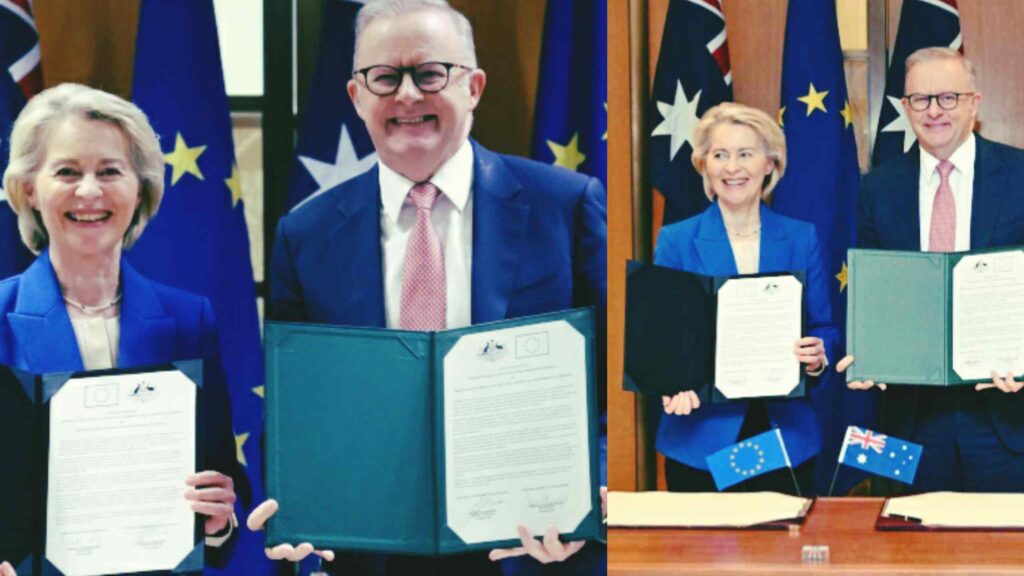
Australia and the European Union signed a long-awaited trade deal on Tuesday, concluding eight years of negotiations. The agreement eliminates tariffs on nearly all European goods and the vast majority of Australian critical mineral exports.
The deal comes amid renewed momentum following the introduction of significantly higher U.S. tariffs under the Trump administration, which prompted both sides to intensify discussions. In addition to the trade pact, the two also signed an agreement aimed at strengthening security and defense cooperation.
European Commission President Ursula von der Leyen emphasized the strong alignment between the EU and Australia, noting that despite their geographical distance, their perspectives on global issues are closely matched. She described the new partnerships in security, defense, and trade as a step that brings them even closer together.
Under the trade agreement, over 99% of EU goods exported to Australia will become tariff-free, saving European companies an estimated €1 billion (approximately $1.2 billion) annually. EU exports to Australia are projected to increase by up to 33% over the next decade.
Australian Prime Minister Anthony Albanese stated that the deal is expected to contribute around A$10 billion ($7 billion) each year to the Australian economy. He also highlighted that removing nearly all import tariffs on Australian critical minerals entering the EU would help stabilize global supply chains.
The EU has been actively working to reduce its reliance on China, particularly in critical minerals, following Beijing’s imposition of export controls on certain key resources. The agreement reflects Europe’s growing engagement in the Indo-Pacific region, building on trade deals struck with Indonesia in September and India in January.
On the services front, the EU will gain expanded access to Australia’s telecommunications and financial sectors. In agriculture, Australian tariffs will be eliminated immediately for wine, sparkling wine, fruit, vegetables, and chocolate, while tariffs on cheeses will be phased out over three years.
Beef, which was a major sticking point that derailed previous talks in 2023, is addressed through two tariff-rate quotas totaling 30,600 tons, with roughly 55% of that volume entering duty-free.
Trade between the two partners is substantial. In 2025, EU firms exported €37 billion worth of goods to Australia, following €28 billion in services exports in 2023. According to official data, the EU was Australia’s third-largest two-way trading partner in 2024 and its sixth-largest export destination. The bloc also ranked as Australia’s second-largest source of foreign investment that year.
Beyond trade, the defense and security agreement will expand intelligence-sharing to address global security threats and deepen collaboration on countering online radicalization and terrorist financing.
About the Author