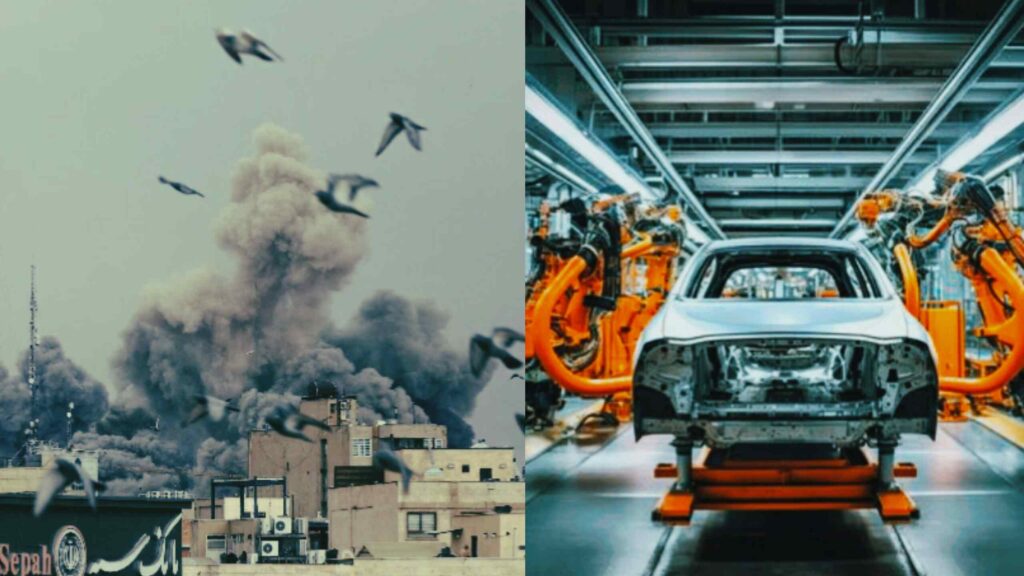
A widening confrontation between the U.S.-Israel alliance and Iran is sending shockwaves through the global automotive industry, effectively halting the flow of millions of vehicles from Asia to the Middle East. As the conflict entered its seventh day on Friday, shipping lines are grinding to a halt, with companies fearing attacks on vessels navigating the strategic Strait of Hormuz.
For Asian automakers, the timing couldn’t be worse. The Middle East represents a cornerstone of their export strategies, and the disruption is threatening billions in revenue.
China Feels the Squeeze
China, in particular, has much at stake. The Gulf region stands as its second-largest overseas market, an increasingly vital outlet as domestic demand softens. According to the China Passenger Car Association, Chinese manufacturers shipped 8.32 million vehicles overseas in 2025. Of those, a staggering 1.39 million—roughly one in every six cars—were destined for Gulf nations like Saudi Arabia and the United Arab Emirates.
Major players like Chery, BYD, SAIC, Changan, and Geely are heavily exposed. Adding to the complexity, Chinese joint ventures with global giants Kia, Hyundai, and Toyota also rank among the top ten exporters to the region, according to supply chain platform Gasgoo.
South Korea’s Record Run Hits a Wall
South Korea’s auto industry, which celebrated record-breaking exports last year, is now bracing for impact. Data from the Korea International Trade Association shows the country shipped $72 billion worth of vehicles globally in 2025. Of that total, $5.3 billion—a 2.8% increase from the previous year—went directly to Middle Eastern markets.
India’s Gulf Dependence Exposed
India’s automotive sector is also feeling the heat. Customs data reveals the country exported $8.8 billion in cars last year, with a full quarter of those shipments—roughly $2.2 billion—headed to the Gulf, primarily Saudi Arabia.
The exposure varies by manufacturer. Hyundai Motor, for instance, shipped half of its $1.8 billion in Indian exports to the region. Toyota’s reliance is even starker: nearly two-thirds of its $470 million in Indian exports—over $300 million—were destined for Middle Eastern buyers.
Other manufacturers have some buffer. Maruti Suzuki sent less than 15% of its export value to the Gulf, equating to $457 million of its total $3.2 billion in overseas sales. Nissan, meanwhile, saw 38% of its Indian exports—about $318 million—head to the region.
For now, the industry is stuck in neutral, watching and waiting as geopolitical tensions threaten to reroute—or outright derail—a critical trade artery.
About the Author